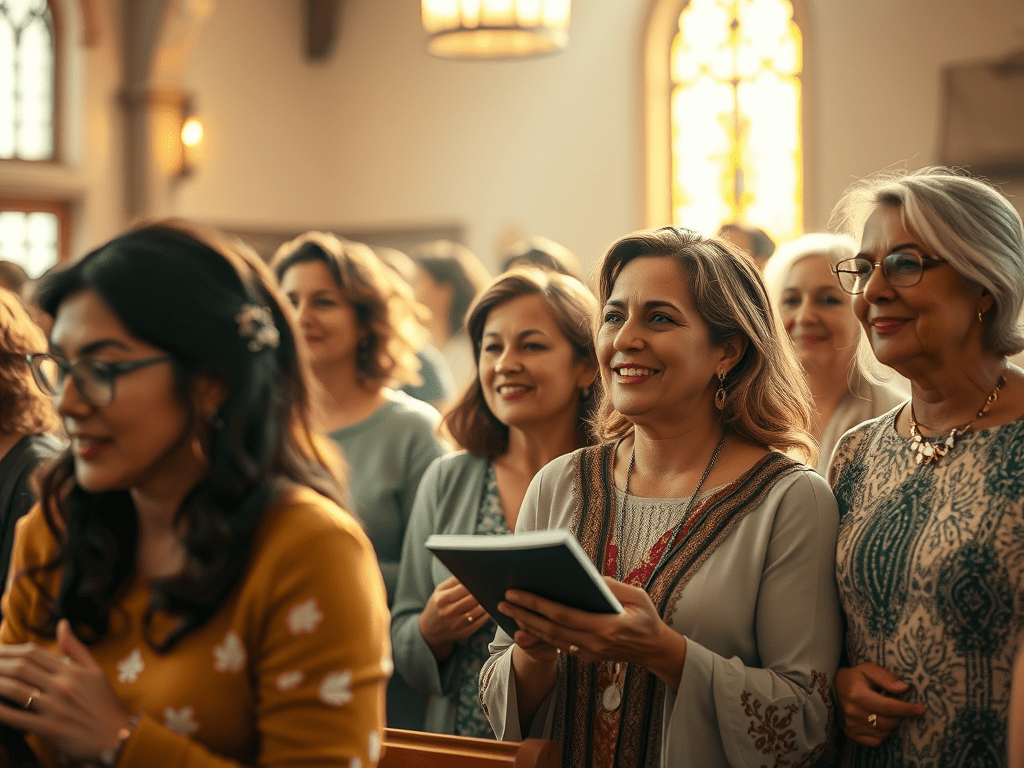
What is the role of women in the Church? To best answer that question, one should simply ask, “What is the role of a woman?” The 26th verse in the Bible reads: And God said, “Let us make humankind in our image and according to our likeness, and let them rule over the fish of the sea, and over the birds of heaven, and over the cattle, and over all the earth, and over every moving thing that moves upon the earth.” So God created humankind in His image, in the likeness of God He created him, male and female He created them.
To really dive into a woman’s role, I will have to build off a presupposed foundation that I do not have the space to unpack here. Genesis chapter 1 places us in a theater where we get to watch the love of the triune God overflow and create an infinite universe, which displays His glorious love and power (Gen 1-2; Ps 19:1-2; Rom 1:20). The pinnacle of this creation is mankind, the human race, which bears God’s own image and is created in His likeness! God created imagers and tasked them to “Be fruitful and multiply, and fill the earth and subdue it, and rule over the fish of the sea and the birds of heaven, and over every animal that moves upon the earth” (Gen 1:27). Genesis 2 gives further insight: “And Yahweh God took the man and set him in the garden of Eden to cultivate it and to keep it” (2:15). God created Adam first and gave him a task. The task was to cultivate and keep the earth and to have dominion over the world.
Yet there was a problem; in an all-good world, one thing was incomplete. Adam was not able to accomplish this task alone—this was not good (Gen 2:18). Yahweh made Adam a helper, and this is where we are first introduced to ‘woman.’ She was made by God for Adam, “a helper as his counterpart” (Gen 2:18). Man by himself cannot properly represent God. Just as God is plurality in unity, so too man and woman (plurality) represent God as one flesh (unity)(Gen 2:24). Thus, “God created humankind in His image…male and female He created them” (Gen 1:27).
We can extrapolate from the first two chapters of the Bible that “men and women are equal in value and dignity.”1 And yet, “men and women have different roles in marriage as part of the created order.”2
What does this have to do with women in the Church? Everything! Sadly, many people think about and approach womanhood like a kid going to work with their dad—they can watch what the men are doing, but they can’t touch anything and need to stay out of the way. This could not be further from God’s design. Women are crucial and vital to help men complete their task. They are helpers and completers. This is a glorious role that only women can fulfill.
Scripture offers a lot of insight as to how biblical womanhood plays out practically:
- Submission (Col 3:18; 1 Pet 3:1; Eph 5:22). This is an inescapable truth and biblically has no negative connotation. Submission exists even within the Godhead! This submission only exists within the husband-wife relationship. There is also a mutual submission that exists between every believer. The submission of the wife to her husband is unique in that she is giving her life, skills, and resources to complete and help the husband in the task that God has called him to. The two exist as one flesh while functioning in different roles. This mystery is great!
- Silence (1 Cor 14:34-35; 1 Tim 2:11-15; 1 Pet 3:1). This does not forbid a woman from talking but forbids a woman from exercising authority in a teaching setting outside of her home. Like the Holy Spirit, a woman’s design and ministry is one that does not have speaking at the forefront. She has the unique ability to take the teaching of men and her husband and to live it out practically and make a home out of it. Like the Godhead, God speaks the Word, and the Spirit beautifies it (Gen 1; Job 26:13). This contrast is seen in Titus 2. Interestingly, both are to be teachers, and yet their methods are different. Men speak (v. 1) and thus teach “sound doctrine,” and women behave (v. 3) and through reverent behavior, they ‘teach’ younger women to love their husbands, children, and be workers at home and subject to their own husband (v. 3-5). This is also evident in 1 Peter 3, where women are to win over disobedient husbands “without a word” (v. 1). Obviously, these two realities have some overlap, but the Bible is concerned with the overall design and function of the genders.
- Love (Tit 2:4). Love is the greatest commandment! And women have a special role of loving their husbands and teaching other women to do the same.
- Homemaker (Tit 2:5; 1 Tim 5:14; Prov 31). This is another description that the world twists to be demeaning, but this is not the case. This is, in fact, a ministry that the Spirit accomplishes in us for the Father and Son. Ferguson sums it up well:
- In the Western world, if a woman who is not employed outside the family home answers the question ‘What do you do?’ by saying, ‘I am a homemaker,’ she may sometimes feel demeaned by the response she receives, such as ‘Oh, so you don’t do anything’ or ‘You don’t do anything else.’ The implication is often this: you are not worth much if that is all you do. Three cheers, then, for Jesus, for using this picture to describe His ‘Best Friend’! Like a homemaker, the Spirit does not draw attention to Himself. His passion is not to glorify Himself but Jesus (16:14) and to transform lives for the Father and the Son to indwell with comfort. In every loving family, the homemaker is well known and much loved, even adored—because she is the one on whom the happiness of the home depends. True, the Spirit glorifies not Himself but Jesus. But that is another reason to honor Him for His ministry.3
- Loyal Completer (Eph 5:22-23; Tit 2:5; 1 Pet 3:1-7).4
Sadly, the world has turned ‘submission’ and ‘silence’ into negative and oppressive terms. God’s Word does not share the same sentiment. The Holy Spirit is called a Helper, and Jesus joyfully submits to the Father as His co-equal. Even God is our “helper” (Ps 54:4). A difference in roles never meant inequality for a whole eternity within the Godhead; submission and authority meaning inequality is a post-fall human invention.
God has given women a full-time job. Being a wife, mother, homemaker, and helper is no easy task. No one would dare say that the Spirit has a lesser or easier job just because He takes a background role to the Son and the Father. Women are not called to be leaders, providers, or fighters; this does mean that they often are not in the spotlight. We think of women as the weak members, but Paul has something to say about that: “On the contrary, it is much truer that the members of the body which seem to be weaker are necessary; and those members of the body which we deem less honorable, on these we bestow more abundant honor, and our less presentable members become much more presentable, whereas our more presentable members have no need of it. But God has so composed the body, giving more abundant honor to that member which lacked, so that there may be no division in the body, but that the members may have the same care for one another. And if one member suffers, all the members suffer with it; if one member is honored, all the members rejoice with it” (1 Cor 12:22-26).
- Grudem, Wayne A. Christian Ethics: An Introduction to Biblical Moral Reasoning. Wheaton, Illinois: Crossway, 2018, 390. ↩︎
- Grudem, 393. ↩︎
- Ferguson, Sinclair B. Lessons from the Upper Room: The Heart of the Savior. First edition. Sanford, FL: Ligonier Ministries, 2021, 97-98.
↩︎ - McQuilkin, J. Robertson, and Paul Copan. An Introduction to Biblical Ethics: Walking in the Way of Wisdom. Third edition. Downers Grove, IL: IVP, an imprint of InterVarsity Press, 2014, 322-333 ↩︎


 Cannons from Canon
Leave a comment